
Your nervous system is the real engine behind every rep. Bodyweight training gives it the feedback it craves.
The mind-muscle connection — known in research as attentional focus or internal cueing — refers to deliberately directing your attention to the muscle you intend to work. When you focus on squeezing your glutes at the top of a bridge rather than simply pushing the floor away, EMG studies show measurably higher activation in the target muscle. Snyder and Leech (2009) demonstrated that internal focus increased biceps activation during curls compared with external focus on moving the weight.
Bodyweight training amplifies this effect because there is no external object to fixate on. During a push-up, you cannot watch a barbell rise — you must feel your chest stretch at the bottom and your triceps extend your elbows. That sensory loop travels from muscle spindles and Golgi tendon organs up to your somatosensory cortex, which updates its internal map of your body.
Over repeated sessions, this map becomes more detailed. Movements that once required conscious effort — keeping ribs down during a hollow-body hold, for instance — gradually become automatic motor patterns stored in your cerebellum. That is motor learning in action, and it is one reason bodyweight skills feel distinctly different from machine reps.
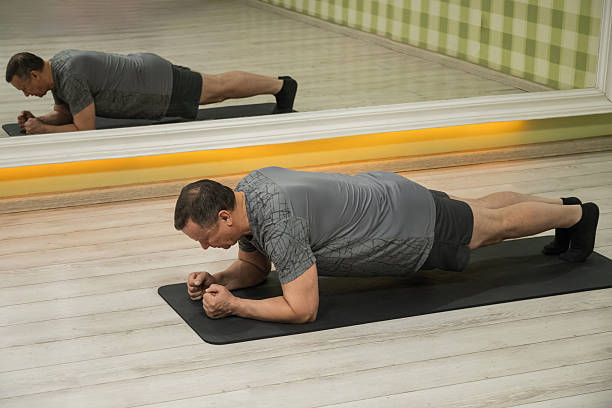
Proprioception is your ability to sense limb position and movement without looking. Bodyweight exercises are proprioception bootcamps.
Stand near a wall for safety, close your eyes, and squat slowly. Without visual input, your ankle and hip proprioceptors work overtime. Start with quarter-depth squats and build over several weeks.
Marching while touching opposite elbow to knee forces your brain to coordinate diagonal movement chains. This integrates left and right hemispheres and mirrors natural gait mechanics.
A 4-1-2-0 tempo (four seconds down, one-second pause, two seconds up, no pause at top) removes momentum and forces conscious control through the full range. Your nervous system cannot cheat.
Good cues are short, sensory, and actionable. Here are four we return to regularly because members report they make an immediate difference in how exercises feel.
Research note: A 2018 meta-analysis in the European Journal of Sport Science found that internal focus of attention produced greater muscle activation in isolation exercises, while external focus benefited performance in skill-based sports. For bodyweight strength work at home, internal cues tend to be more useful.
Highly focused training is neurologically demanding. If you feel mentally drained after a session, that is normal. Keep mindful sessions to 30–45 minutes and sleep well afterwards.
Always have a wall, chair back, or spotter nearby for balance drills with eyes closed. Start on firm, level flooring. Stop if you feel disoriented.
| Date | Event | Time |
|---|---|---|
| 14 June 2026 | Foundation Flow (Tempo Focus) | 6:30 PM |
| 26 July 2026 | Mindful Movement Workshop | 9:30 AM |
| 9 August 2026 | Breath & Body Integration | 6:30 PM |
Not at all. Beginners often benefit most because they are building motor patterns from scratch. Simple cues on wall push-ups or bodyweight squats lay the foundation for harder skills later.
It can during learning phases. Once a pattern is automatic, you can shift to external focus (e.g., "push the floor") for speed work. Both have their place in a balanced programme.
They share attention-training qualities but serve different purposes. A focused bodyweight session is movement practice, not a substitute for dedicated relaxation or mindfulness routines.